
The Goal, Not the Brochure
Why better study-abroad decisions begin with objectives, not rankings.
Twenty years ago, families asked:
Where can I find information?
Today they ask:
Which information can I trust?
Information is no longer scarce. It is overwhelming.
Rankings. Brochures. TikTok advice. Agents. Alumni stories. Immigration updates. AI predictions.
And when information becomes abundant, the challenge is no longer finding it.
It is deciding what matters.
What families face today is no longer an information problem.
It is a decision problem.
When I started writing this book, I thought I was writing a guide.
A guide to immigration. A guide to careers. A guide to choosing courses, universities and study destinations.
Then I realised the problem.
Immigration rules change faster than a British summer forecast. Some courses risk becoming obsolete before the student who started them graduates. Technology is reshaping careers in real time. The conditions that produced yesterday’s success may not exist tomorrow.
Any guide I wrote would be out of date before you reached the final chapter.
So I wrote something that doesn’t expire.
I changed the question.
Instead of asking, "What advice do families need today?", I asked:
"What framework will help families make good decisions when tomorrow may look nothing like today?"
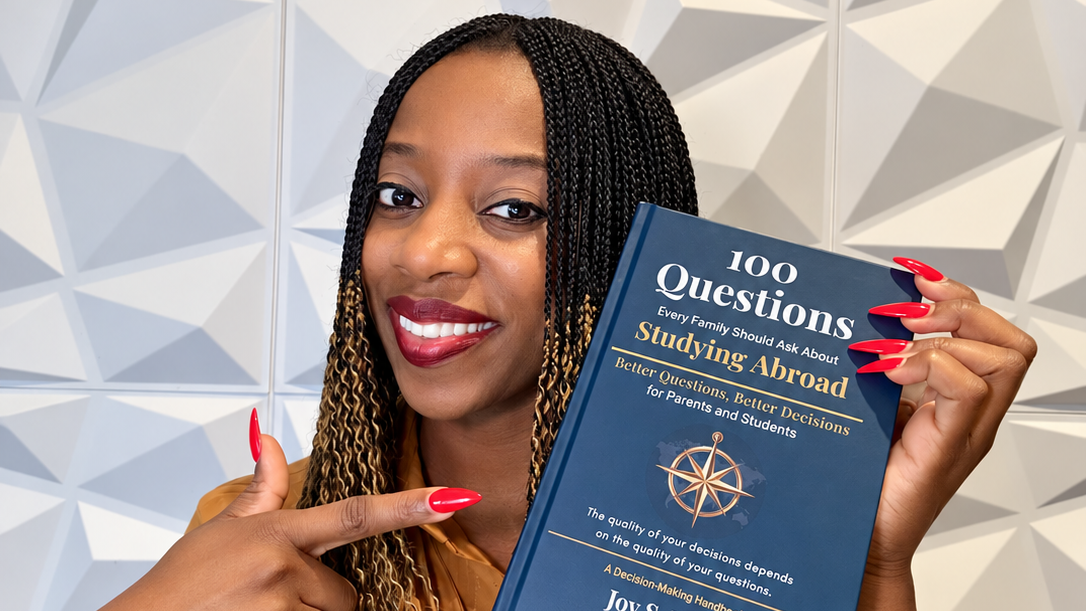
That became the foundation of 100 Questions Every Family Should Ask About Studying Abroad.
After more than two decades in international education, first as an international student and later working within universities, I have sat on both sides of the table. I have seen families make life-changing decisions, some exceptionally good and others incredibly costly.
I learned this lesson myself early in my own study-abroad journey: access to information is not enough if you do not know what you are trying to achieve, or which questions to ask. And I have seen the same pattern ever since.
The families who made the strongest decisions were not necessarily the ones with the most information. They were the ones who understood the goal and asked the right questions.
That does not mean information does not matter. It does. But information only becomes useful when it is drawn from credible sources, interrogated, weighted, and tested against a clearly defined goal.
Because there is no universally "best" university.
There is no universally "best" country.
There is no universally "best" course.
There is only the option that best fits your goal, your finances, your risk appetite, your child's readiness and the trade-offs you are prepared to make.
Much of the industry asks, "Which is best?"
The better question is:
"Best for what?"
And the answer begins with your goal.
Families who make stronger decisions tend to decide first what they are truly trying to achieve, and only then judge the course, the university and the country through that lens.
Too many do the reverse: they fall in love with a place, then force the goal to fit.
And some of the most important truths are the ones neither a brochure nor a ranking can tell you:
→ Someone else's success is not your plan. Success leaves clues, but not instructions. A graduate who succeeded five years ago did so under different immigration rules, fees and job markets. Their outcome is evidence, not a guarantee.
→ A famous network does not guarantee access. Opportunity and outcome are two very different things.
→ The cheapest option can cost you what matters most. If it damages your child's wellbeing, confidence or ability to succeed, was it really cheaper?
→ Even the best choice will fail a child who is not ready.
These decisions cannot be made by looking at one factor in isolation.
Cost matters.
Employability matters.
Immigration matters.
Teaching quality matters.
Wellbeing matters.
Readiness matters.
But the real skill is understanding how much weight each factor should carry for your family, and your goal is what decides that weight.
That is what this book is designed to help you do.
It covers the 10 most expensive mistakes I have repeatedly seen families make, but it goes much further than identifying mistakes.
The 100 Questions are not simply a checklist. They are a decision framework built around one principle: different objectives require different questions, different trade-offs and ultimately different decisions.
A way to interrogate marketing.
A way to evaluate courses, countries and universities.
A way to think about future careers and changing skills.
A way to test whether your options genuinely serve your objective.
A way to understand risk and trade-offs.
And a way to assess the advice you receive.
Too often, advice in international education is standardised, built on the assumption that every student wants the same thing.
They do not.
A student hoping to migrate, a professional looking to accelerate their career, a future researcher and a young person seeking greater independence may all be considering the same university, but they are making very different decisions.
That is why the book identifies eight student archetypes.
Each one connects to different objectives, priorities and questions.
The framework is designed to adapt to the student’s objective, rather than forcing every family through the same decision process.
The book also deliberately avoids naming institutions or recommending countries wherever possible.
That is intentional.
I wanted readers to evaluate options independently, rather than inherit my preferences.
The purpose of the book is not to point you towards a particular answer.
It is to give you the tools to reach your own.
International education is an industry built to sell education.
That does not mean the advice is bad.
It means families still need the ability to evaluate it.
Seek professional advice, absolutely.
But evaluate the adviser too.
Trust the guide, but check the map.
The stakes can be enormous.
For some families, the financial investment can run into tens or even hundreds of thousands of pounds, alongside years of commitment, expectation and risk.
Understanding what you are buying, why you are buying it, and what must happen for that investment to deliver the outcome you want is not a luxury.
It is a necessity.
This book is for anyone who influences a study-abroad decision: students, parents, relatives, teachers, counsellors and advisers.
When a student finds the option that genuinely fits their goals, abilities and circumstances, everyone benefits.
The student is more likely to succeed.
The family is more likely to feel the investment was worthwhile.
And the institutions and advisers involved are more likely to earn trust, recommendations and long-term credibility.
For those who prefer to listen or explore particular sections in more depth, I have also created a companion YouTube series covering the mistakes, the archetypes, the objectives and the questions.
The future will keep changing.
Good decision-making has to survive those changes.
That is what I wanted to create.
Not simply another study-abroad guide.
A framework for thinking.
A toolkit for evaluating.
And 100 questions designed to help families take ownership of one of the most important decisions they may ever make.
Because this book is not only about teaching families how to decide.
It is about teaching them how to think.
The ownership of a decision this important should never be outsourced.
Let your goal guide the choice, not the brochure.
Good luck.