
Beyond Illustration: Vinschool Central Park Students Explore Creative Futures with Ulearniverse
A student-led initiative in Ho Chi Minh City brought young creatives together to ask bigger questions about illustration, university and where artistic talent can lead.
What happens when students interested in illustration decide to help other young creatives think more carefully about their futures?
At Vinschool Central Park in Ho Chi Minh City, Vietnam, a group of final-year students did exactly that.
Through Project BLUE, an initiative created by students for students, they set out to encourage their peers to explore illustration and the possibilities of pursuing a future in the creative industries.
As part of the project, Ulearniverse Founder and Managing Director Joy Musa was invited to join the students for a conversation about university choices, creative careers and what young people should consider before making one of their first major educational investments.
Ten questions shaped the conversation
Rather than simply asking for a presentation about the “best universities” for illustration, the students prepared ten questions in advance.
They wanted to know whether university was necessary to become an illustrator; what skills and opportunities university could provide; whether there were alternatives to committing to three or four years of study; what internships were available; which countries and institutions they should consider; what documents and qualifications they would need; whether SATs or IELTS were necessary; how important their portfolios would be; whether not taking A Levels would disadvantage them; and what employers actually look for when recruiting illustrators.
Those questions transformed the session from a university presentation into a much broader discussion about how young people should make decisions about their futures.
One message quickly emerged: there is rarely one universally “best” university, country or pathway.
The better question is:
Best for what?
Looking at the same decision from different perspectives
A student who wants to specialise deeply in illustration, manga, animation or character design may benefit from a specialist creative institution.
Look at the same decision through the lens of career flexibility, however, and another possibility emerges. Could that artistic ability be combined with architecture, fashion, product design, UX, computing or another discipline that opens additional professional doors?
Change the perspective to cost, and the answer may change again. A prestigious private creative institution may offer exceptional specialist training and industry connections, while a public or government-subsidised university could provide a strong education at a fraction of the cost.
Look through the lens of industry, and illustration suddenly extends far beyond publishing. Creative talent is needed across animation, games, film and television, fashion, advertising, technology, automotive, product development and many other sectors.
And look through the lens of entrepreneurship, and employment may not even be the final destination. A creative graduate might eventually build a studio, brand, agency or other business of their own.
Same student.
Same creative talent.
Different perspective. Different answer.
A U-Camp connection comes full circle
The invitation had another special connection to Ulearniverse.
One of the students involved in the initiative, Thuy Chi, had previously participated in U-Camp's Arts & Design programme in Malaysia.
Her involvement made the occasion particularly meaningful for Ulearniverse: a former U-Camp participant who had taken part in an international creative experience was now contributing to a student-led initiative encouraging other young people to explore their own creative futures.
U-Camp experiences are intended to give young people opportunities to explore interests, experience different environments and develop ideas about what might come next.
Seeing a former participant contribute to an initiative created by students, for students was therefore a particularly rewarding connection.
The students' gift: Endless Perspectivism
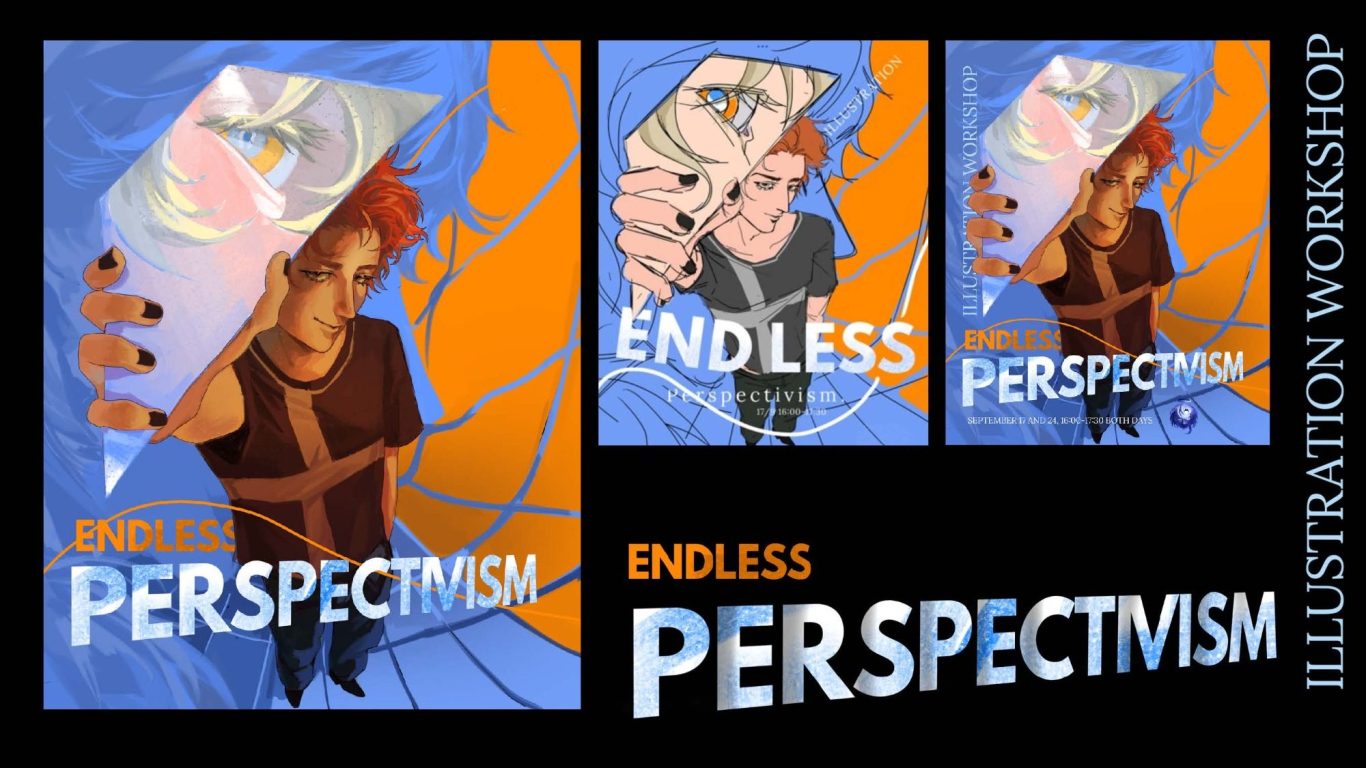
At the end of the session, the students presented Joy with artwork created as part of Project BLUE, including a striking body of work entitled Endless Perspectivism.
Across the work, characters and visual elements are repeatedly reframed. Details move between foreground and background; faces and eyes are enlarged, cropped and recontextualised; and illustration is combined with graphic design, typography, digital production and a distinctive visual identity.
One detail particularly caught Joy's attention: the gold/yellow appearing prominently in the characters' eyes is echoed in the centre of the Project BLUE identity.
The students themselves are, of course, best placed to explain the intended inspiration and meaning behind their creative decisions.
But the title Endless Perspectivism created an unexpected parallel with the discussion that had just taken place.
The students had arrived with questions about studying illustration.
The conversation had repeatedly demonstrated that the answer depended on the perspective from which the question was considered.
Specialism produced one answer.
Cost produced another.
Career optionality introduced another.
Industry, international experience, employment opportunities and entrepreneurship each changed the picture again.
It was an unexpected connection between the students' creative work and the central idea of the session: sometimes making a better decision doesn't begin with finding another answer.
It begins by looking at the same question from another perspective.
The value of asking better questions
For Joy, the discussion also connected with a principle that has shaped much of her work with students and families:
“The quality of your decisions depends on the quality of your questions.”
Young people today are making education and career decisions in a world being rapidly reshaped by technology, AI, new industries and changing ways of working.
The challenge is therefore not simply to choose a degree.
It is to understand what you are trying to achieve, what skills you need, what an education will genuinely add, what alternatives exist, what opportunities it may create and whether the investment makes sense for you and your family.
For the students behind Project BLUE, illustration provided the starting point.
Their ten questions took the conversation somewhere much bigger.
And Endless Perspectivism provided a fitting final reminder:
Sometimes the possibilities change when you change the perspective.